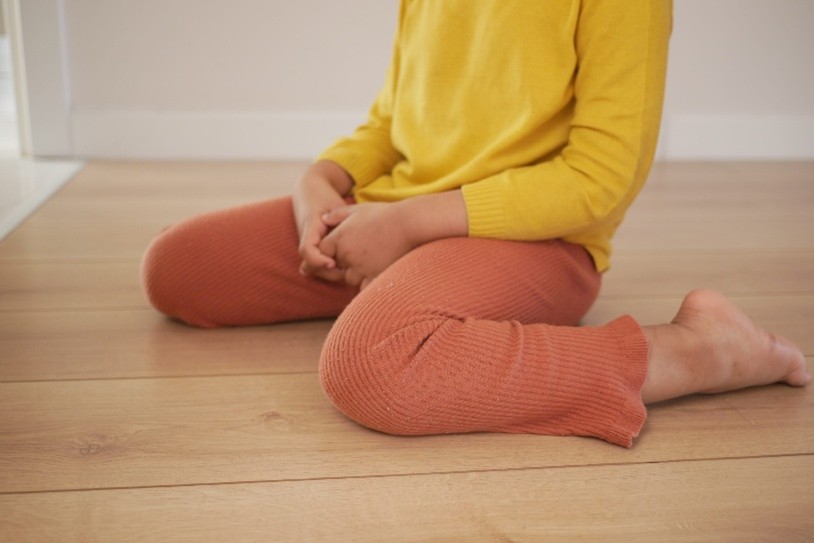
‘W-sitting’ is a term used to describe when children sit with their bottom on the floor, their knees bent in front of them, and their lower legs splayed out to their sides so that it creates a ‘W’ shape from above. There is a lot of conversation and conflicting information online about why a child might W-sit and what effect this may or may not have on a child’s development. It can be confusing to navigate all this content – so, is W-sitting really a bad thing?
Disclaimer: These statements and advice are for typically-developing children and do not replace specialised advice for children with specific diagnoses.
Typical Bony Development
Understanding how a child’s bones develop and change over time can provide helpful context to why you might find your child sitting in a ‘W’ position.
To fit inside the womb, babies are in a curled-up and folded position. Specifically, their thigh bones (femurs) are twisted inwards; this is referred to as ‘femoral anteversion’ and is part of normal development. Once babies are born, their lower limb bones progressively ‘untwist’ and this process takes years (up to age 8-10 years). This explains why what is considered ‘normal bony alignment’ for a child looks different at different ages, and is different to adults. For example, it is typical for an infant/toddler to present more bow-legged, and a 4-6 year-old to present more knock-kneed.
The increased femoral anteversion younger children have essentially means that W-sitting is not only an easy position to achieve, but a pretty comfortable one. As children grow older and their femoral anteversion reduces, W-sitting becomes a harder and much less comfortable position to sit in so naturally, they often stop W-sitting without intervention. However, some individuals may retain their ability to W-sit – this might be due to certain presentations such as generalised joint hypermobility.
Myth Busting
A common statement parents may come across when searching up W-sitting online is that W-sitting “damages hips” and therefore, parents should actively discourage their child from W-sitting. However, the published research evidence tells a different story.
A systematic review published in 2025 found that:
Most arguments against W-sitting lack quality evidence and/or use evidence inadequately or inappropriately.
There is no evidence that proves that W-sitting causes Developmental Hip Dysplasia.
There is no evidence that proves that W-sitting causes core muscle weakness.
There is no evidence that proves that W-sitting causes other orthopaedic issues such as in-toeing (pigeon-toed posture).
Therefore, there is no current published, high-quality research evidence that proves that W-sitting is harmful for typically-developing children.
The Bigger Picture
Sometimes, in a small proportion of children, the preference to W-sit can be just one piece of a bigger puzzle. These children often present with other physical abnormalities and/or developmental challenges. It is then a health professional’s responsibility to screen these children who may require further specialised intervention.
A review with a health professional is recommended if your child presents with the following (in addition to W-sitting):
- Developmental delays
- Differences in muscle tone
- Frequent falls and balance issues
- Pain and/or a limp
- Asymmetrical posture (eg. one foot turning inwards)
- Inability to sit in positions other than W-sitting
However, if you are still worried about your child’s sitting preferences, it is always a good idea to check in with your local paediatric physiotherapist.
Blog written by Maddie Dal Corobbo.
For more information or to book an appointment, please contact The Physio Clinic on 8342 1233.
Recommended further reading: https://westernkidshealth.com/early-intervention/w-sitting-why-the-drama/