
Vision significantly influences how we move our bodies and explore our surroundings. Think about the vast information we take in everyday just from seeing – noticing other people’s facial expressions, reading written information displayed on a poster, or noticing an obstacle in the way. Vision helps us establish where our body is in space, how our body is positioned, and where other objects are in space. Vision also plays a crucial role in how we maintain our balance.
Children with vision impairments often require additional support and time to develop their gross motor skills such as independent walking, navigating stairs, balancing on uneven surfaces, and learning object control skills (eg. ball skills).
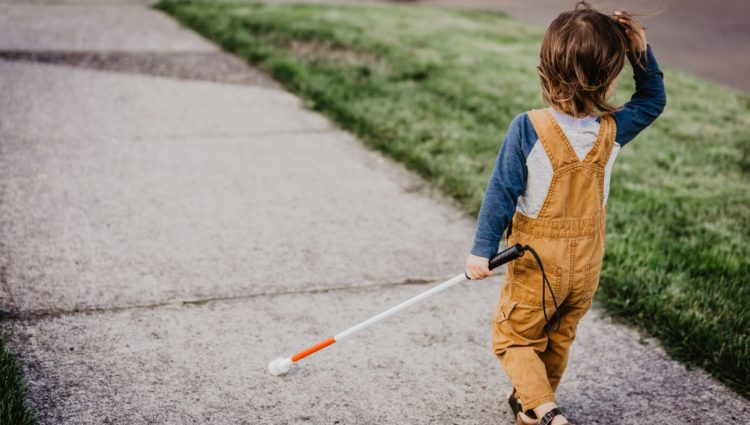
Ocular Impairment vs Cerebral Vision Impairment (CVI)
An individual with ocular impairment has difficulty obtaining a good visual image, due to changes in the structure and/or function of the eye itself. They are able to process and interpret the image appropriately when provided with enough information.
An individual with CVI does not present with impairments in the structure and/or function of the eye itself. Instead, there are changes in the parts of the brain that interpret visual information. This means that they may see an image but may not be able to interpret it appropriately. It is like someone speaking to you in a foreign language; you can hear that they are speaking, but you do not know what they are saying.
What Does Research Say?
The development of motor skills should be monitored closely in early childhood to identify support needs.
Those with more severe vision loss had greater difficulty developing their motor skills.
Children with vision impairment who were supported to participate in sports demonstrated improved skills – intervention and participation make a difference!
Compared to their sighted peers, children with vision impairment demonstrate:
Delayed fine motor and gross motor skill development.
Reduced bilateral coordination skills.
Challenges with sensory integration.
Increased sedentary time and reduced physical activity.
Challenges with accessing opportunities for gross motor development.
How can physiotherapy help?
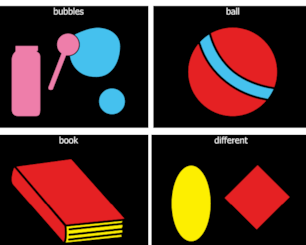
For children with vision impairment, looking and processing visual information can be overwhelming and tiring. It is important to work with the functional vision they do have (ie. a strength-based approach) and support them to develop new skills or compensatory strategies to support their independence with daily activities. This might look like:
- Providing 1:1 support to try, explore, and develop gross motor skills – crawling, walking, jumping, stairs, climbing, throwing, catching, kicking and more!
- Providing specific intervention working on developing muscle strength, balance and coordination.
- Supporting the child to explore using other senses, like touch.
- Providing non-visual prompts to support the child to learn a new motor skill eg. verbally describing what is around them or hand-over-hand demonstration.
- Using visual supports and communication that is suited to their vision eg. high-contrast pictures.
- Allowing for increased processing time, repetition, and consistency to build confidence and develop motor patterns.
- Prescribing mobility aids (eg. a walker) or other specialised equipment where appropriate.
- Teaching compensatory strategies like feeling the direction of a rail to interpret depth changes.
- Collaborating with the child’s support team to facilitate their access to and participation in a variety of environments and activities.
- Connecting the child to appropriate services which can provide support outside of the physiotherapy scope.
By Maddie Dal Corobbo (Senior Physiotherapist – Paediatric Team)
If you would like more information or to book an appointment with a physiotherapist from our paediatrics team, please call The Physio Clinic on 8342 1233.
Reference:
Ebrahimi E, Salsali M, Sheikhhoseini R, Ghasemian M. Assessment of Gross and Fine Motor Skills in Children With Visual Impairment: A Systematic Review and Meta-analysis. Journal of Pediatrics Review. 2024; 12(3):261-272. http://dx.doi.org/10.32598/ jpr.12.3.1128.3